
For three years, all Jerrell Powe wanted to do was play football for the University of Mississippi. This fall, he'll finally get that wish.
The Jerrell Powe sage came to an end Monday as the Southeastern Conference deemed the 21-year-old defensive lineman fully eligible to practice and play football this season for the Rebels.
"I am deeply grateful to Ole Miss and to the SEC for the opportunity to be admitted here and to prove that I can succeed academically and on the football field," Powe said in a statement. "I have always had faith and a plan, and both are beginning to show results."
For those of you not familiar with this unbelievable story, here's a brief timeline provided by the Memphis Commercial Appeal:
Feb. 2, 2005: Powe, a five-star recruit and one of the nation's most feared defensive lineman, signed with Ole Miss
Aug. 4, 2005: Powe was declared academically ineligible
Feb. 1, 2006: Powe again signed with Ole Miss after spending a year at the Hargrave Military Academy in Virginia
Aug. 26, 2006: Powe was declared academically ineligible by the NCAA, which contended that Powe had received too much assistance completing his coursework
Aug. 8, 2007: Powe, who was diagnosed with learning disabilities, including dyslexia, re-took courses at his high school and Penn Foster Career School during the year, and then signed with Ole Miss for a third time
Aug. 28, 2007: Powe was declared academically ineligible, but was allowed to receive financial aid and attend classes in Oxford
July 28, 2008: After Powe completed 24 credit hours over two semesters with a 2.31 GPA, he was declared eligible by the NCAA and will play for Ole Miss this season
I strongly encourage you to read the full article because the short version simply does not do Jerrell Powe's story justice. Coincidentally, I was reading Bruce Feldman's book Meat Market this afternoon, which provides an inside account of Ole Miss recruiting under former coach Ed Orgeron, and Powe's recruitment in particular.
Orgeron, who convinced Powe to play for him despite offers from SEC powerhouses LSU and Auburn, never could have imagined then that it would take three long years for his prized recruit to play a down for the Rebels.
And while Orgeron may not be here to coach him (he was fired after the 2007 season), you can bet that he broke into a smile upon hearing the news.
"He just kept working hard, kept believing, and finally his dream's coming true," said Marcus Boyles, Powe's high school coach. "I couldn't be happier for him. The thing I'm proudest of is that this young man never quit. He got knocked down a few times. People kept saying that it would never happen, never happen, never happen. And finally, it happened."
Showing posts with label NCAA. Show all posts
Showing posts with label NCAA. Show all posts
Tuesday, July 29, 2008


Monday, July 28, 2008
Should college athletes be paid?
The question has been debated for years: Should college athletes be paid? And for the longest time, my answer was an unequivocal "yes."
However, yesterday's article in the Atlanta Journal-Constitution got me thinking a little deeper.
The AJC also includes a guest column by Dr. Boyce Watkins, who makes a compelling case to pay student-athletes:
On the whole, Watkins' assertion is sadly far too accurate: the NCAA is no longer the "amateur institution" it claims to be. Watkins goes on to argue that "the problem is that the NCAA is allowed to operate as a cartel."
In other words, all schools work together to make price-fixing agreements that prevent players from having any other options. This practice is illegal in nearly every other industry, because the source of labor then has no bargaining power.
NCAA President Myles Brand has the pleasure of presenting the case for the other side, and guess what? His argument is equally, if not more, compelling than Watkins':
If both sides are right, what's the solution? For starters, I don't buy the educational argument from Brand and others until all universities make a real commitment to helping their student-athletes graduate.
Furthermore, I think that Drs. Watkins and Richard E. Lapchick, president and CEO of the National Consortium for Academics and Sport and founder of the Center for the Study of Sport in Society, are on to something.
Their suggestion is to "tilt financial assistance toward under-privileged student-athletes," especially when the time commitment to their teams makes it impossible for them to earn part-time jobs.
"I've always felt that student-athletes should get some additional income, particularly those who come from families with less than traditional support," Lapchick said. "It's a huge, big business. Somehow, we have to find a way to give student-athletes more of a fair share."
Watkins said, "It makes no sense that a guy could be worth $10 million or $15 million a year to a school, and his mother is being evicted from her apartment."
No, it doesn't. Not at all. And while it's pretty clear that Brand will never pay student-athletes under his watch, Watkins and Lapchick may have found a pretty good compromise.
However, yesterday's article in the Atlanta Journal-Constitution got me thinking a little deeper.
The AJC also includes a guest column by Dr. Boyce Watkins, who makes a compelling case to pay student-athletes:
I have witnessed students being taken out of class for an entire week to play in a nationally-televised football or basketball game, with academics (and the fact that the student's grade has been jeopardized) becoming an afterthought. Players are treated like professional athletes, not students, and a weak performance on the field will cause them to lose their scholarship. Any institution operating as a government-sanctioned cartel, riddled with hypocrisy, disproportionate and exploitative compensation schemes, and glaring disregard for educational values should be scrutinized more carefully.
On the whole, Watkins' assertion is sadly far too accurate: the NCAA is no longer the "amateur institution" it claims to be. Watkins goes on to argue that "the problem is that the NCAA is allowed to operate as a cartel."
In other words, all schools work together to make price-fixing agreements that prevent players from having any other options. This practice is illegal in nearly every other industry, because the source of labor then has no bargaining power.
NCAA President Myles Brand has the pleasure of presenting the case for the other side, and guess what? His argument is equally, if not more, compelling than Watkins':
Here is big news. Student-athletes have always been the only amateurs in amateur collegiate sports. From nearly the beginning of college sports 150 years ago, there have been paid coaches, and then paid administrators, and then all the rest. They are professionals. Intercollegiate athletics is their job.
Playing sports is not the "job" of students. They are not professionals at playing sports. They are amateurs.
If both sides are right, what's the solution? For starters, I don't buy the educational argument from Brand and others until all universities make a real commitment to helping their student-athletes graduate.
Furthermore, I think that Drs. Watkins and Richard E. Lapchick, president and CEO of the National Consortium for Academics and Sport and founder of the Center for the Study of Sport in Society, are on to something.
Their suggestion is to "tilt financial assistance toward under-privileged student-athletes," especially when the time commitment to their teams makes it impossible for them to earn part-time jobs.
"I've always felt that student-athletes should get some additional income, particularly those who come from families with less than traditional support," Lapchick said. "It's a huge, big business. Somehow, we have to find a way to give student-athletes more of a fair share."
Watkins said, "It makes no sense that a guy could be worth $10 million or $15 million a year to a school, and his mother is being evicted from her apartment."
No, it doesn't. Not at all. And while it's pretty clear that Brand will never pay student-athletes under his watch, Watkins and Lapchick may have found a pretty good compromise.
Sunday, July 27, 2008
New rules put college baseball coaches in a bind
Think all Vanderbilt student-athletes are coming to school for free? Think again.
Our friends at The College Baseball Blog alerted me to an interesting story in today's Dallas Morning News that sheds light on the scarcity of Division I scholarships:
For baseball coaches like Vanderbilt's Tim Corbin, it just got even harder.
Beginning this fall, the NCAA will adopt stricter scholarship and transfer rules in order to eliminate "tryout scholarships" and drive up player retention, according to Brian Davis of the Dallas Morning News.
Roster size limits will be put in place (no more than 35) and teams must now give 30 players at least 25 percent of a full scholarship. Beginning in 2009-10, that number will drop to 27. Keep in mind that baseball programs have just 11.7 scholarships available to begin with. Also, players will now be required to sit out one year if they transfer to another NCAA school.
The rule changes were enacted "to help improve grades in in a sport long criticized as having some of the worst GPAs in college sports," Davis writes.
Still, many coaches are opposed, most notably former Mississippi State coach Ron Polk, who wrote a passionate 18-page letter describing how this rule, along with others, was ruining the game. Here are a few Polk's major points:
1. College baseball gives out the smallest number of scholarships based on the average roster size of each sport, both men and women. It has just 11.7 scholarships to spread among a team with 35+ players.
2. College baseball is now the only sport that will have a roster cap placed on teams' coaches and players.
3. College baseball is now the only "equivalency" sport that is required to provide a minimum scholarship (25%) and determine the number of players who can receive scholarships (30).
4. College baseball is now the only "equivalency" sport that will have a no-transfer rule. All other "equivalency" sports allow student-athletes to transfer one time without being forced to sit out a year.
Here's one example that should help illustrate why these changes are problematic:
Say, for instance, that Vanderbilt coach Tim Corbin has 24 underclassmen in his program. Of those 24, he thinks four will be drafted in June's MLB Draft, which would leave him with 20 returning players.
Therefore, he offers seven recruits a partial scholarship. Then, the four players he thought he would lose in the draft decide to return to school for their senior seasons. And since all the recruits decide to enroll, Corbin is left with 31 players, although just 27 are allowed to be on scholarship.
Now, what does Corbin do? Four of those players will either have to become one of the eight alloted walk-ons (since the roster cap is 35) or transfer to another school, where they'll have to sit out a year before being eligible to play.
As Polk put it, "The coach who does not care about student welfare will always have to go over his number in the recruiting process, for the only way he can ever hit the magic number 27 on the button is by protecting himself and his baseball program by signing more players in hopes that he somehow can work himself down to 27 players on scholarship. The caring coach interested in student-athlete welfare could be facing situations every year where he has well below the 27 scholarship players, for he refused to gamble with a student's welfare. Who is going to win more baseball games? The answer is very easy: the uncaring coach."
I'm going to get Corbin's thoughts on the rule changes when I return to campus in a couple of weeks, but I think I know where he stands, and that's right next to Ron Polk.
Our friends at The College Baseball Blog alerted me to an interesting story in today's Dallas Morning News that sheds light on the scarcity of Division I scholarships:
The NCAA considers revenue sports football and basketball "head-count" sports, meaning all the scholarships awarded in those sports are full – typically room, board, tuition, fees, books and meals. On the women's side, basketball, gymnastics, tennis and volleyball fall into that category.
The rest of the sports offered by universities are considered "equivalency" sports and can divide scholarships. The minimum amount of aid that can be awarded is 25 percent, meaning a student-athlete might receive books and meals but nothing else.
"Even for the parents of top players, they are still going to have to participate financially and participate in a fairly significant way," said Texas baseball coach Augie Garrido, who has won five national titles and more games than any other baseball coach in Division I history.
Having to divvy up the financial aid puts coaches in a precarious position.
For baseball coaches like Vanderbilt's Tim Corbin, it just got even harder.
Beginning this fall, the NCAA will adopt stricter scholarship and transfer rules in order to eliminate "tryout scholarships" and drive up player retention, according to Brian Davis of the Dallas Morning News.
Roster size limits will be put in place (no more than 35) and teams must now give 30 players at least 25 percent of a full scholarship. Beginning in 2009-10, that number will drop to 27. Keep in mind that baseball programs have just 11.7 scholarships available to begin with. Also, players will now be required to sit out one year if they transfer to another NCAA school.
The rule changes were enacted "to help improve grades in in a sport long criticized as having some of the worst GPAs in college sports," Davis writes.
Still, many coaches are opposed, most notably former Mississippi State coach Ron Polk, who wrote a passionate 18-page letter describing how this rule, along with others, was ruining the game. Here are a few Polk's major points:
1. College baseball gives out the smallest number of scholarships based on the average roster size of each sport, both men and women. It has just 11.7 scholarships to spread among a team with 35+ players.
2. College baseball is now the only sport that will have a roster cap placed on teams' coaches and players.
3. College baseball is now the only "equivalency" sport that is required to provide a minimum scholarship (25%) and determine the number of players who can receive scholarships (30).
Texas A&M coach Rob Childress can list several players he's coached who came to school on less than 25-percent scholarships. Take A&M sophomore right-hander Travis Starling, for example.
Starling redshirted in 2006 and appeared in 15 games in 2007. Last season, Starling was 8-2 with a 3.70 ERA for the Big 12 champion Aggies.
"The stories you've heard about the Travis Starlings of the world, that's going to be a thing of the past and that's sad," Childress said.
4. College baseball is now the only "equivalency" sport that will have a no-transfer rule. All other "equivalency" sports allow student-athletes to transfer one time without being forced to sit out a year.
Here's one example that should help illustrate why these changes are problematic:
Say, for instance, that Vanderbilt coach Tim Corbin has 24 underclassmen in his program. Of those 24, he thinks four will be drafted in June's MLB Draft, which would leave him with 20 returning players.
Therefore, he offers seven recruits a partial scholarship. Then, the four players he thought he would lose in the draft decide to return to school for their senior seasons. And since all the recruits decide to enroll, Corbin is left with 31 players, although just 27 are allowed to be on scholarship.
Now, what does Corbin do? Four of those players will either have to become one of the eight alloted walk-ons (since the roster cap is 35) or transfer to another school, where they'll have to sit out a year before being eligible to play.
As Polk put it, "The coach who does not care about student welfare will always have to go over his number in the recruiting process, for the only way he can ever hit the magic number 27 on the button is by protecting himself and his baseball program by signing more players in hopes that he somehow can work himself down to 27 players on scholarship. The caring coach interested in student-athlete welfare could be facing situations every year where he has well below the 27 scholarship players, for he refused to gamble with a student's welfare. Who is going to win more baseball games? The answer is very easy: the uncaring coach."
I'm going to get Corbin's thoughts on the rule changes when I return to campus in a couple of weeks, but I think I know where he stands, and that's right next to Ron Polk.
Monday, May 12, 2008
Should NBA remove minimum-age rule?
Sports Illustrated's Luke Winn does a great job articulating what we have been discussing here regarding the recent O.J. Mayo investigation. It's a must-read.
Essentially, Winn has two main points:
First, that USC coach Tim Floyd isn't dumb or naive enough to not have connected the dots and known that Guillory-arranged goods would be dirty. He had hoped the situation wouldn't implode and now that it has, Floyd and the rest of the USC athletic department are going to plead ignorance. While Winn says the Trojans deserve major penalties, he wouldn't be surprised if the NCAA and its mostly powerless investigative unit fails to prove any culpability for Floyd or USC.
Second, Winn questions the purpose of the NBA's minimum-age rule, which was adopted two years ago.
Winn lists some of the parties, beyond Guillory and BDA, who benefited by forcing super talents like Mayo and Michael Beasley to come to school for a year.
-USC, from ticket sales, Mayo jerseys ($75 each), increased exposure
-Magazines, from featuring Mayo on their cover
-TV Networks, from televising Mayo's games
-The NCAA, from "getting higher TV ratings due ratings due to the presence of young stars such as Mayo, Beasley, Kevin Love and Derrick Rose."
Which brings us to Winn's conclusion:
"When one takes off the basketball blinders and looks back at the recent Freshman Era, it's hard not to feel guilty about promoting the age limit as a positive thing, about trumpeting these stars as real collegians. Let players on the take jump straight to the NBA, if only so colleges don't have to deal with the Guillorys of the underworld and the rest of us don't have to endure the charade of labeling characters like Mayo 'student-athletes.'"
So that's my question to you guys: Should the NCAA remove its minimum-age ("one-and-done") rule?
I think Sonny Vaccaro makes it pretty clear how he feels about the rule in his interview on the Dan Patrick radio show. You can listen to it here.
A few of the highlights:
SV: "You have to blind-deaf not to understand that these kids are coming for one year and not to understand that there's really no dedication to the school they're going to. There's nothing that ties them to the school forever....When everyone's making money...and the kids are getting dreck, Dan, it's a very easy formula to understand. I'll say this till I die: It's not a fair system. They shouldn't be in school to begin with and there should not be a one-year purgatory. There's no way that should be human. It's not right."
SV: "My point is this: let them go out of high school. If they don't get drafted, let this institution called the NCAA take them back with open arms and then make them sign an agreement: you have to stay for three years. You eliminate the hypocrisy."
DP: It's not a "student-athlete" any more. It's an "athlete-student" and the NCAA should drop this nonsense.
SV: That's the fight I'm fighting and what I'm trying to get the public to understand. Just don't come down and beat on the kids. The most egregious parties are the universities and the NCAA."
DP: I know. The phrase "student-athlete" an oxymoron.
SV: "The kids are not innocent. There's no innocence to this at all. But they're put into a situation by the NCAA and by the NBA that they wouldn't have to be put in. Allow them to go pro. The one-year-and-out thing is the biggest fraud that the NCAA has ever come up with."
I don't know about you, but I'm in full agreement with Sonny. And he's not the only one who thinks that way.
Bobby Knight called it "the worst thing that's happened to college basketball since I've been coaching" and the New York Times' Harvey Araton agreed.
Araton also touched on the underlying racial element to this issue when he said this:
"After all these years, I am happy to agree with Knight on something, especially an issue that has long troubled me: the paternalistic attitudes regarding athletes and college, self-servingly tailored to keep a large base of African-American basketball players from having the same choices as high school graduates in baseball and hockey."
I know people don't usual like to talk about race, but I think Araton makes an interesting point.
Additionally, as CBSSportsline's Gary Parrish points out, "the make-it-to-the-NBA rate for top 10 high school prospects is remarkably high," which means there is no good reason that these highly-skilled players should be forced to spend a year in college pretending to be student-athletes when they're already good enough to play at the highest level.
Essentially, Winn has two main points:
First, that USC coach Tim Floyd isn't dumb or naive enough to not have connected the dots and known that Guillory-arranged goods would be dirty. He had hoped the situation wouldn't implode and now that it has, Floyd and the rest of the USC athletic department are going to plead ignorance. While Winn says the Trojans deserve major penalties, he wouldn't be surprised if the NCAA and its mostly powerless investigative unit fails to prove any culpability for Floyd or USC.
Second, Winn questions the purpose of the NBA's minimum-age rule, which was adopted two years ago.
Winn lists some of the parties, beyond Guillory and BDA, who benefited by forcing super talents like Mayo and Michael Beasley to come to school for a year.
-USC, from ticket sales, Mayo jerseys ($75 each), increased exposure
-Magazines, from featuring Mayo on their cover
-TV Networks, from televising Mayo's games
-The NCAA, from "getting higher TV ratings due ratings due to the presence of young stars such as Mayo, Beasley, Kevin Love and Derrick Rose."
Which brings us to Winn's conclusion:
"When one takes off the basketball blinders and looks back at the recent Freshman Era, it's hard not to feel guilty about promoting the age limit as a positive thing, about trumpeting these stars as real collegians. Let players on the take jump straight to the NBA, if only so colleges don't have to deal with the Guillorys of the underworld and the rest of us don't have to endure the charade of labeling characters like Mayo 'student-athletes.'"
So that's my question to you guys: Should the NCAA remove its minimum-age ("one-and-done") rule?
I think Sonny Vaccaro makes it pretty clear how he feels about the rule in his interview on the Dan Patrick radio show. You can listen to it here.
A few of the highlights:
SV: "You have to blind-deaf not to understand that these kids are coming for one year and not to understand that there's really no dedication to the school they're going to. There's nothing that ties them to the school forever....When everyone's making money...and the kids are getting dreck, Dan, it's a very easy formula to understand. I'll say this till I die: It's not a fair system. They shouldn't be in school to begin with and there should not be a one-year purgatory. There's no way that should be human. It's not right."
SV: "My point is this: let them go out of high school. If they don't get drafted, let this institution called the NCAA take them back with open arms and then make them sign an agreement: you have to stay for three years. You eliminate the hypocrisy."
DP: It's not a "student-athlete" any more. It's an "athlete-student" and the NCAA should drop this nonsense.
SV: That's the fight I'm fighting and what I'm trying to get the public to understand. Just don't come down and beat on the kids. The most egregious parties are the universities and the NCAA."
DP: I know. The phrase "student-athlete" an oxymoron.
SV: "The kids are not innocent. There's no innocence to this at all. But they're put into a situation by the NCAA and by the NBA that they wouldn't have to be put in. Allow them to go pro. The one-year-and-out thing is the biggest fraud that the NCAA has ever come up with."
I don't know about you, but I'm in full agreement with Sonny. And he's not the only one who thinks that way.
Bobby Knight called it "the worst thing that's happened to college basketball since I've been coaching" and the New York Times' Harvey Araton agreed.
Araton also touched on the underlying racial element to this issue when he said this:
"After all these years, I am happy to agree with Knight on something, especially an issue that has long troubled me: the paternalistic attitudes regarding athletes and college, self-servingly tailored to keep a large base of African-American basketball players from having the same choices as high school graduates in baseball and hockey."
I know people don't usual like to talk about race, but I think Araton makes an interesting point.
Additionally, as CBSSportsline's Gary Parrish points out, "the make-it-to-the-NBA rate for top 10 high school prospects is remarkably high," which means there is no good reason that these highly-skilled players should be forced to spend a year in college pretending to be student-athletes when they're already good enough to play at the highest level.
Video of the Day: O.J. Mayo Investigation
The fact that prized high school and college athletes are receiving improper benefits from runners and agents shouldn't come as a shock to anyone.
Still, ESPN's "Outside the Lines" investigation of USC basketball player O.J. Mayo was too thorough to ignore. Here's a clip of the show in which reporter Kelly Naqi interviews Louis Johnson, a former member of Mayo's inner circle. I think it says a lot about the state of big-time college athletics as a whole.
I'm off to the dentist, but feel free to keep the discussion going on the post below and I'll be back later this afternoon. Hopefully.
Still, ESPN's "Outside the Lines" investigation of USC basketball player O.J. Mayo was too thorough to ignore. Here's a clip of the show in which reporter Kelly Naqi interviews Louis Johnson, a former member of Mayo's inner circle. I think it says a lot about the state of big-time college athletics as a whole.
I'm off to the dentist, but feel free to keep the discussion going on the post below and I'll be back later this afternoon. Hopefully.
Sunday, May 11, 2008
Mayo allegations speak to state of NCAA
The story isn't surprising, but revealing nonetheless.
Former USC basketball player O.J. Mayo received thousands of dollars in cash, clothes and other benefits while he was still in high school and during his one year in college, a former Mayo associate told ESPN's "Outside the Lines."
ESPN's investigation was thorough as illustrated by Kelly Naqi's well-reported story.
This story is about much more than O.J. Mayo. It speaks to the nature of the NCAA, which has become nothing like the "amateur institution" that it wants us to believe.
"This is way bigger than some 'brand' and money and all of this stuff," said Louis Johnson, a former member of Mayo's inner circle. "He played within the rules of the game, and this is the game. Runners, agents, shoe companies, other elements -- this is the game. … Once you're in the game, you're in the game. There's no turning back."
ESPN's Pat Forde couldn't agree more.
In his latest column, Forde says that USC and coach Tim Floyd have no excuses.
An excerpt from his column:
I couldn't have said it better myself.
Former USC basketball player O.J. Mayo received thousands of dollars in cash, clothes and other benefits while he was still in high school and during his one year in college, a former Mayo associate told ESPN's "Outside the Lines."
ESPN's investigation was thorough as illustrated by Kelly Naqi's well-reported story.
This story is about much more than O.J. Mayo. It speaks to the nature of the NCAA, which has become nothing like the "amateur institution" that it wants us to believe.
"This is way bigger than some 'brand' and money and all of this stuff," said Louis Johnson, a former member of Mayo's inner circle. "He played within the rules of the game, and this is the game. Runners, agents, shoe companies, other elements -- this is the game. … Once you're in the game, you're in the game. There's no turning back."
ESPN's Pat Forde couldn't agree more.
In his latest column, Forde says that USC and coach Tim Floyd have no excuses.
An excerpt from his column:
You have to assume USC simply didn't want to know. Didn't want to know the extent to which runners already had set their hooks into their highest-profile basketball recruit ever. The Trojans knew they were in this deal for one year before Mayo turned pro, and they probably just averted their gaze, hoping nothing blew up and the victories would pile up.
It's a scenario playing out right now on many other campuses nationwide, guaranteed. Agents and their runners are identifying who can play as early as college scouts are, and they're commencing the jockeying for position. And we all know what wins most of those turf wars: money and favors. Most topflight young basketball players have at least been offered plenty before college, even if they haven't accepted it.
It's a problem the NCAA desperately needs to get a grip on if college basketball is going to maintain even a hint of a legitimate relationship to higher education. The sport's repeatedly pilloried reputation took another big hit with this revelation, but perhaps it will spur other Louis Johnsons to tell the truth about what's going on in college hoops and youth basketball.
I couldn't have said it better myself.
Wednesday, May 7, 2008
Vandy in elite company
When the NCAA released its most recent Academic Progress Rates yesterday, many schools were nervous, hoping that their teams finished above the 925 threshold to avoid possible penalties. Vanderbilt, meanwhile, had nothing to worry about.
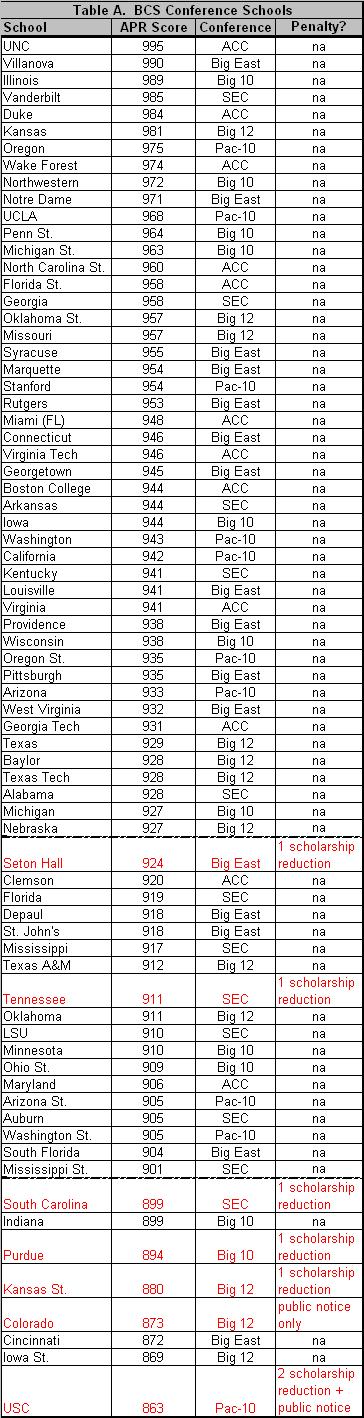
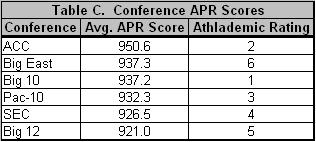
The Commodores' men's basketball team finished an impressive fourth among BCS Conference schools with an APR Score of 985, behind only UNC, Villanova and Illinois (see chart below). Every Division I sports team calculates its APR each academic year, based on the eligibility, retention and graduation of each scholarship student-athlete.
Note that Tennessee and South Carolina, among others, lost one scholarship each for poor academic performance.
The reason Vanderbilt scores so well is twofold. Of course, Vanderbilt's admissions standards for athletes are different than, say, Tennessee's, but I don't think that's the main reason. I think that the high grade is more of a reflection on the commitment that the university as a whole, and the respective teams in particular, make to their student-athletes both on the court and in the classroom.
From the coaching staffs to the academic advisers, there are resources available to ensure that Vanderbilt's student-athletes are successful. They want their players to graduate and do everything they can to help them do so.
The Commodores' men's basketball team finished an impressive fourth among BCS Conference schools with an APR Score of 985, behind only UNC, Villanova and Illinois (see chart below). Every Division I sports team calculates its APR each academic year, based on the eligibility, retention and graduation of each scholarship student-athlete.
Note that Tennessee and South Carolina, among others, lost one scholarship each for poor academic performance.
The reason Vanderbilt scores so well is twofold. Of course, Vanderbilt's admissions standards for athletes are different than, say, Tennessee's, but I don't think that's the main reason. I think that the high grade is more of a reflection on the commitment that the university as a whole, and the respective teams in particular, make to their student-athletes both on the court and in the classroom.
From the coaching staffs to the academic advisers, there are resources available to ensure that Vanderbilt's student-athletes are successful. They want their players to graduate and do everything they can to help them do so.
'Academic reform is here to stay'
The NCAA hit more than 200 college sports teams with scholarship reductions and other sanctions because of academic shortcomings, the USA Today reported Tuesday.
Some of the programs included Tennessee and five others that were in the NCAA men's basketball tournament and two Bowl Championship Series entrants, Kansas and Hawaii, in football.
"Academic reform is here to stay. ... It's been in place now for four years," NCAA President Myles Brand said. "Everyone — coaches, ADs, presidents and student-athletes — should understand that's the order of the day."
According to the article, the programs "posted subpar academic progress rates (APRs), which have been computed by the NCAA for the last four years and hinge on retaining players, keeping them academically eligible and ultimately graduating them. Twenty-six teams — including 20 in the longtime problem sports of men's basketball, football and baseball — were flagged as chronic underperformers and handed stiffer penalties, including reductions in practice time."
Still, more than a third of the 329 Division I schools had at least one team penalized.
Some of the programs included Tennessee and five others that were in the NCAA men's basketball tournament and two Bowl Championship Series entrants, Kansas and Hawaii, in football.
"Academic reform is here to stay. ... It's been in place now for four years," NCAA President Myles Brand said. "Everyone — coaches, ADs, presidents and student-athletes — should understand that's the order of the day."
According to the article, the programs "posted subpar academic progress rates (APRs), which have been computed by the NCAA for the last four years and hinge on retaining players, keeping them academically eligible and ultimately graduating them. Twenty-six teams — including 20 in the longtime problem sports of men's basketball, football and baseball — were flagged as chronic underperformers and handed stiffer penalties, including reductions in practice time."
Still, more than a third of the 329 Division I schools had at least one team penalized.
Two major-college football programs, Alabama at Birmingham and San Jose State, were docked nine scholarships each. Washington State and Idaho each lost eight.
Men's basketball, in particular, "remains a serious problem," Brand said.
53 programs were sanctioned, including 39 that drew scholarship cuts or practice restrictions. Tennessee lost one scholarship, as did Purdue, Kansas State and South Alabama, while Southern California lost two.
They were hit with the NCAA's first phase of penalties, given annually to programs with APRs below 925 (on a scale to 1000) and preventing them from replacing scholarship athletes who've left while academically ineligible.
The NCAA compiles APRs for every one of the 6,272 men's and women's sports teams in Division I. Points are awarded, player by player, and the association has determined that teams should hit 92.5% of their possible total — an APR of 925. That roughly projects a 60% graduation rate.
At the same time, there were 507 teams that posted APRs below 925 but didn't draw sanctions because they had no athletes who left school while academically ineligible or their schools sought and received waivers — granted by the NCAA when there are mitigating circumstances and the institution has an acceptable academic improvement plan.
Among those who received exceptions were LSU and Florida (men's basketball) and South Carolina (football).
"That raises the question: How can so many schools avoid sanctions?" said Nathan Tublitz, a neuroscience professor at Oregon who co-chairs the Coalition on Intercollegiate Athletics, an alliance of faculty senates at Division I universities. "One can understand a few exceptions. One can understand that some schools have good reasons. But for so many schools to have so many good reasons raises the question of whether there's really any bite to this academic performance package and the sanctions that are supposed to be issued."
Tublitz is a "very strong supporter" of the overall package, he said. "It's just that if you're going to set up a program that has a cutoff score, you have to stick to that cutoff score and not continue to give schools a free ride. If they don't make it after four years, what's going to happen after five? What's going to happen after six? How many times does a school get an exception?"
I couldn't agree more with Tublitz's assessment. I like the fact that the NCAA is making a commitment to academics, but if it's not going to follow through on its penalties, then it looks like its efforts are just for show.
Subscribe to:
Posts (Atom)



 Posts
Posts


